Cricket has changed significantly with the introduction of technology. One of the biggest developments in modern cricket is the Decision Review System, commonly known as DRS in Cricket. It has transformed the way important umpiring decisions are checked and has given teams an opportunity to challenge certain decisions when they believe an error has been made.
Before DRS was introduced, players had to accept the on-field umpire’s decision even when television replays suggested that the decision might have been incorrect. Today, technologies such as ball tracking, UltraEdge, slow-motion replays and multiple camera angles help match officials examine important incidents more closely.
Understanding DRS in Cricket is useful for both new and experienced cricket fans because the system involves specific rules, review limits and technological checks. It is not simply a matter of watching a replay; every review follows a defined process.
What Is DRS in Cricket?
DRS in Cricket stands for the Decision Review System. It is a technology-assisted process used to review certain decisions made by the on-field umpires.
When a team believes that an umpire has made an incorrect decision, a player can request a review within the permitted time. The third umpire then examines the available evidence using the appropriate technology and communicates the findings to the on-field umpire.
The primary purpose of the system is to reduce clear and significant umpiring errors while maintaining the authority of the officials on the field.
How Does the Cricket Review System Work?
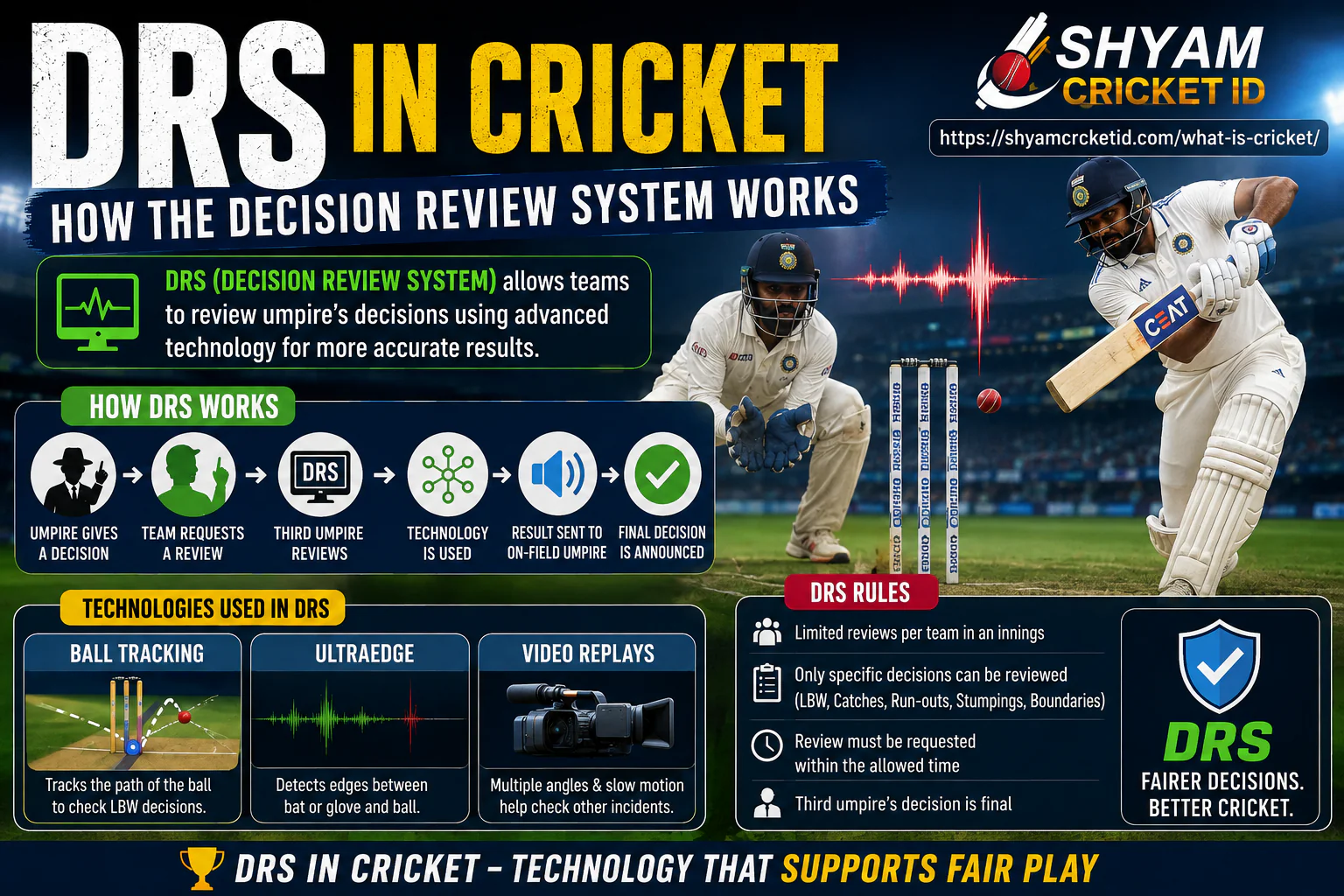
The DRS in Cricket review process generally follows a sequence of steps:
- The on-field umpire makes a decision.
- A player decides whether the decision should be reviewed.
- The review is requested within the permitted time.
- The on-field umpire signals for the review.
- The third umpire examines the available evidence.
- Relevant technologies are used depending on the incident.
- The third umpire communicates the outcome to the on-field umpire.
- The final decision is announced.
Different technologies are used depending on whether the review concerns an LBW, catch, run-out, stumping or another reviewable incident.
Technologies Used in DRS
Modern DRS in Cricket depends on several technologies to help officials examine important incidents.
Ball Tracking
Ball tracking is particularly important when an LBW decision is reviewed. It estimates the delivery’s trajectory and helps determine whether the ball would have hit the stumps.
The technology helps establish:
- Where the ball pitched
- Where the ball struck the batter
- The predicted path of the ball
- Whether the ball would have hit the wickets
Ball tracking provides information that can be difficult for the human eye to determine during a fast delivery.
UltraEdge
UltraEdge is primarily used to determine whether the ball made contact with the bat or glove.
For example, when a batter is given out caught behind, the third umpire can use the available visual and audio evidence to determine whether there was an edge.
This makes DRS in Cricket particularly valuable for close caught-behind decisions where the contact between bat and ball may be extremely difficult to see in real time.
Video Replays
Video replay is another essential part of the review process. Multiple camera angles and slow-motion footage can help officials examine catches, run-outs, stumpings, boundaries and other incidents.
In some situations, a single camera angle may not provide enough information. The third umpire can therefore review footage from different angles before reaching a conclusion.
What Are the Main DRS Rules?
The exact regulations for DRS in Cricket can vary according to the competition and playing conditions, but several principles generally apply.
1. A Player Must Request the Review
Teams cannot request a review whenever they want. A review must be requested within the specified period after the umpire makes the decision.
The captain or designated player normally communicates the request to the on-field umpire.
2. Teams Have Limited Reviews
Teams receive a limited number of unsuccessful reviews per innings under the applicable playing conditions. Therefore, players need to make strategic decisions about when to use them.
A review that overturns or otherwise qualifies under the relevant rules can be treated differently from an unsuccessful review.
3. Only Certain Decisions Can Be Reviewed
Not every umpiring decision can automatically be reviewed. Depending on the competition’s regulations, reviews can involve incidents such as:
- LBW decisions
- Catches
- Run-outs
- Stumpings
- Certain boundary decisions
- Other incidents covered by the playing conditions
The exact scope depends on the rules of the particular match or tournament.
4. The Third Umpire Examines the Evidence
During DRS in Cricket, the third umpire reviews the available evidence and applies the relevant playing conditions.
The third umpire may use video footage, ball tracking, UltraEdge and other available information before communicating the outcome to the on-field umpire.
What Happens During an LBW Review?
LBW is one of the most familiar situations involving DRS in Cricket.
When an LBW decision is reviewed, the third umpire generally examines several key questions. The process can include checking whether the delivery was legal, where it pitched, whether the batter made contact with the ball using the bat first, where the ball struck the batter and whether the projected path would have hit the stumps.
Ball-tracking technology is particularly important at this stage because it provides a projected trajectory of the delivery.
For example, a review may show that the ball pitched in line, struck the batter in a relevant area and would have gone on to hit the wickets. The final decision is then made according to the applicable laws and review protocols.
What Is Umpire’s Call in DRS?
One of the most discussed elements of DRS in Cricket is Umpire’s Call.
Umpire’s Call applies in specific situations where ball-tracking technology indicates that the outcome falls within a defined margin or threshold. In such circumstances, the original on-field decision can remain unchanged.
This principle recognizes that ball-tracking is a technological prediction and that some marginal situations do not provide enough evidence to completely overturn the umpire’s original decision.
Therefore, DRS is designed to assist the on-field umpire rather than completely replace the umpire’s judgment.
Why Is DRS Important in Cricket?
The introduction of DRS in Cricket has provided several benefits to modern cricket.
Greater Accuracy
Technology gives officials additional evidence that may not be visible to the naked eye. This can be especially useful for close LBW, caught-behind, run-out and stumping decisions.
Helps Correct Clear Errors
A clear umpiring mistake can potentially be overturned after the available evidence is examined. This gives teams an additional opportunity to achieve a more accurate result.
Greater Transparency
Fans can often see the replays and understand why a decision was changed or allowed to stand. This has added another level of transparency to important moments.
Supports Match Officials
The system is intended to support umpires rather than undermine them. The on-field umpire remains an important part of the decision-making process, while the third umpire and technology provide additional evidence.
Limitations of DRS
Although DRS in Cricket has improved decision-making, it is not completely free from limitations.
Ball-tracking technology provides a projected trajectory rather than physically showing what would happen to the ball. Some decisions also involve interpretation, while marginal cases can generate debate among players and supporters.
Umpire’s Call is another aspect that sometimes creates confusion. Fans may see technology indicating that a ball is close to the stumps but still see the original decision retained because the result falls within the applicable Umpire’s Call criteria.
Technology can therefore improve the decision-making process without eliminating every area of uncertainty.
DRS in Test, ODI and T20 Cricket
The use of DRS in Cricket can be found across different formats, including Test cricket, One Day Internationals and T20 cricket, subject to the playing conditions of the relevant competition.
The number of reviews available, review procedures and specific technological provisions can differ between competitions. For this reason, players, teams and viewers should understand the regulations applicable to the particular match.
The system has become an important part of professional cricket because a single decision can sometimes have a major effect on the outcome of a match.
Why Do Players Need to Use DRS Strategically?
DRS in Cricket is not only a technological tool; it can also be a strategic resource.
Teams have a limited number of unsuccessful reviews, so players need to assess the situation before making a request. A captain may consult the batter, bowler or wicketkeeper before deciding whether a review has a reasonable chance of succeeding.
For example, a confident bowler may request a review after an LBW decision, while a wicketkeeper may immediately believe that there was an edge behind the wicket. The team must then decide whether the available evidence is strong enough to justify using its review.
This strategic element adds another layer of decision-making to modern cricket.
Frequently Asked Questions About DRS Cricket
What does DRS stand for in cricket?
DRS stands for Decision Review System. It is a technology-assisted process used to review certain decisions made by the on-field umpire.
What does DRS help to review?
Depending on the competition’s rules, DRS in Cricket can be used for incidents such as LBW decisions, catches, run-outs, stumpings and certain boundary-related decisions.
Who makes the final decision with DRS?
The third umpire examines the available evidence and communicates the result to the on-field umpire. The final decision is then communicated according to the applicable review procedure.
What is Umpire’s Call?
Umpire’s Call is a part of the review process in certain marginal situations. When the ball-tracking outcome falls within the defined parameters, the original on-field decision can remain unchanged.
Can every cricket decision be reviewed?
No. Only decisions and incidents covered by the applicable DRS and competition rules can be reviewed.
Why was DRS introduced?
The system was introduced to help reduce clear errors in important umpiring decisions by providing additional evidence through technology.
Is DRS used in every cricket match?
Not necessarily. Its availability and specific rules depend on the competition and its playing conditions.
Final Thoughts
DRS in Cricket has become an important part of modern cricket and has changed how crucial umpiring decisions are examined. The combination of experienced umpires and technologies such as ball tracking, UltraEdge and video replay allows officials to make better-informed decisions.
From LBW appeals and close catches to run-outs and stumpings, the review system can provide valuable evidence when an incident is difficult to judge in real time. At the same time, concepts such as Umpire’s Call demonstrate that technology is designed to assist rather than completely replace the judgment of the on-field officials.
For cricket fans, understanding DRS in Cricket makes it easier to follow reviews and understand why a decision is changed, confirmed or left with the original umpire’s call.