
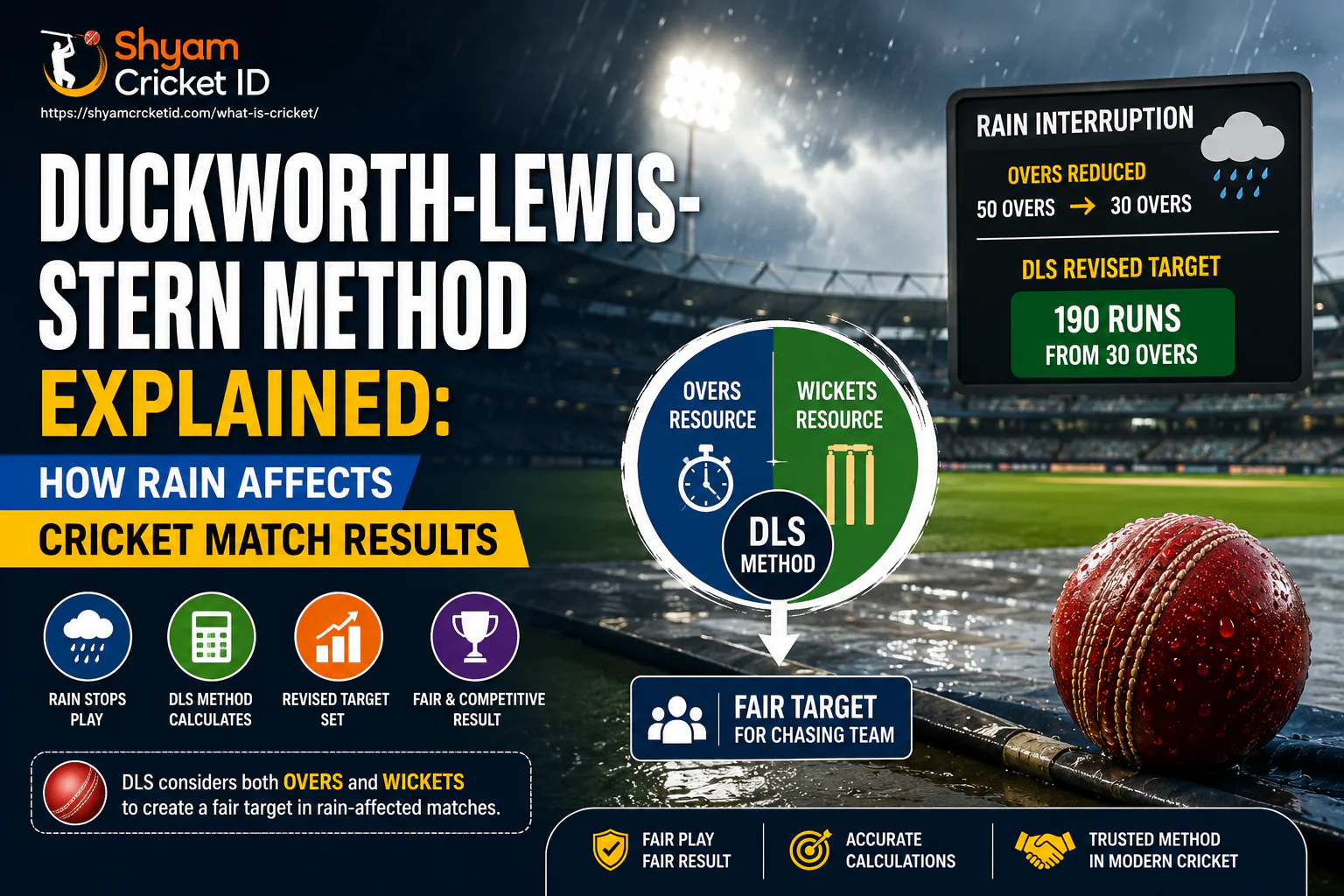
It is possible to say that in cricket, weather may significantly influence the result of the game. If there is rain in the middle of a limited-overs game, teams may not be able to play the same number of overs, thus losing some playing time. That is why the DLS method, also called Duckworth Lewis Stern method, is applied to cricket.
The DLS method is a mathematical method of revision of targets in rain-affected limited-overs games. It does not imply reduction of the target depending on the number of overs lost; instead, it takes into account the resources left to a batting team, which include overs and wickets.
What Is the Duckworth Lewis Stern Method ?
The Duckworth Lewis Stern approach is a methodology which is employed to compute an adjusted target in a situation where rain or any other hindrance causes a reduction in the number of overs available in the cricket game.
It has been developed by statisticians Frank Duckworth and Tony Lewis and then altered by Steven Stern. The methodology is now extensively used in international limited overs cricket.
The concept underlying DLS approach in cricket is that a team has two major scoring resources:
- Number of overs available
- Number of wickets available
A cricket batting team having 10 wickets and many overs has far more scoring resources as compared to a team which has lost many wickets and few overs available.
Why Is the DLS Method Needed?
Suppose that Team A makes 250 runs for 50 overs. When Team B goes to bat, it rains after 10 overs.
If Team B’s target had been calculated by only taking the overs into consideration, it would be an unfair method because the ability of Team B to score runs not only depends upon the number of overs but also the availability of wickets.
Thus, DLS cricket guidelines provide a way of calculating the revised target, which considers the resources available for Team B.
This makes the rain interrupted cricket game more competitive as well as mathematical.
How Does DLS Work in Cricket?
The fundamental concept of the Duckworth Lewis Stern method revolves around the concept of resource percentage.
A side starts an innings with 100% resources available at their disposal.
As the game proceeds and overs are bowled with wickets falling, the resource percentage reduces.
In case a side starts an innings with Duckworth Lewis Stern Method
- 50 overs
- 10 wickets
- 100% resource is available at their disposal.
In case of interruptions in an innings by rain or light, the resource consumed is calculated by the Duckworth Lewis Stern Method for the side.
A new target is calculated based on the available resources of the chasing side relative to the side setting the target.
DLS Method in Cricket: Simple Example
Let us assume that Team A makes 280 runs out of 50 overs. Duckworth Lewis Stern Method
The team follows up its performance by batting but gets stopped in their play due to some rain in between. Team B therefore gets only 30 overs instead of the 50 overs initially assumed.
It is not appropriate to continue with the same target score of 281 runs as 20 overs have been lost as opportunities to score in favor of Team B.
The DLS formula in cricket provides an updated target score based on the resources available to Team B.
Let us assume that the new target score is 190 runs out of 30 overs. Team B needs 190 runs to win.
What Are the DLS Cricket Rules? Duckworth Lewis Stern Method
The DLS method rules take into consideration the disruptions that may occur during limited overs cricket games. Some of the key aspects include:
- Overs lost owing to rain
If there are fewer overs due to rain, then the target for the chasing team can be adjusted.
- Importance of Wickets
The importance of the wickets lost becomes important as the wickets signify one of the team’s batting resources.
- Target Can Be Modified Multiple Times
In the event of several interruptions of play due to rains, the target can be revised every time there is a significant alteration in the playing conditions.
- Minimum Number of Overs Required
The regulations of a game can also lay down the minimum number of overs needed to have a result.
- Delays During First Innings May Be Significant Too Duckworth Lewis Stern Method
In case of interruptions due to rain during the first innings, the team batting first will have been given fewer overs. The target for second innings will be set based on the DLS method.
What Happens When Rain Interrupts a Match?
Effect of Rain Based on the Time of Disruption
Rain Prior to the Game
In the event that rain occurs prior to the commencement of the game, the officials might decrease the number of overs for both sides. The game will then be a limited-overs game.
Rain during First Innings
If the disruption occurs at first innings, the officials might reduce the number of overs available to the batting team. The target score of the second team will be based on the new conditions.
Rain in the Second Innings
It is one of the situations that make the DLS method very useful for cricket.
There could be a case whereby the chasing side might have scored a certain number of runs before the rain stopped play and after resumption of play, the remaining overs are calculated.
What If a Team Is Ahead or Behind on DLS?
If there is a game of cricket which is affected by the weather, then the score of that game may be compared with the DLS par score.
The DLS par score is the score of the chasing side as it would have made up to this point if there were no changes to the condition of play.
If the chasing side is ahead of the required DLS par score in case the match can no longer go on, then it may be considered as the winning side of the game, subject to the regulation of the event. Duckworth Lewis Stern Method
If it is not, then the side may lose.
Why Doesn’t DLS Simply Divide the Target?
The misconception that people have about rain is that reducing the target is simply based on the percentage of overs lost. Duckworth Lewis Stern Method
For instance, when the 50-over game is reduced to 25 overs, people may think that the target will become half the original score.
However, this could be seen as unjust since a team with nine wickets left has more scoring chances than a team with only three wickets left. Duckworth Lewis Stern Method
Moreover, the number of overs that were lost during different stages of the game will also affect it differently.
It is for this reason that the D/L/S method is based on overs as well as wickets and not just on the simple runs per over formula.
DLS and Modern Cricket Duckworth Lewis Stern Method
DLS in cricket has now become an integral component of limited overs cricket, especially in international games and tournaments.
It offers officials a mathematical approach that helps to handle interruptions. Although spectators may sometimes find revised targets difficult to understand, the system aims at reducing any advantage or disadvantage arising out of unpredictable weather conditions.
Modern technology has also enabled the application of DLS calculations more conveniently in live games. Officials and TV broadcasters can instantly show revised targets, par score, and required rate of scoring runs.
Frequently Asked Questions Duckworth Lewis Stern Method
What does DLS mean in cricket?
DLS is the acronym for Duckworth Lewis Stern Method , which is a mathematical way of adjusting the target in case of interruption in limited-overs cricket.
What is the DLS method in cricket?
The DLS method in cricket adjusts the target of the match in case of an interruption due to rain, resulting in a reduction in the number of overs played.
Does DLS take wickets into account?
Yes, both wickets and overs are taken into consideration in this method as both are resources of batting.
Does DLS apply to Test cricket? Duckworth Lewis Stern Method
Duckworth Lewis Stern Method is basically related to limited-overs cricket and not Test cricket.
Does DLS impact the target of a team?
Yes. If the interruption leads to a reduction in the duration of the play, then the target will be recalculated based on the DLS formula.
What does DLS contribute to a rain-hit cricket game?
DLS assists in generating a fair target where both teams don’t have the same duration of play and batting resources.
Is DLS the same in all cricket games?
The process involved is standard; however, the application depends on the competition rules.
Final Thoughts Duckworth Lewis Stern Method
In conclusion,The DLS Method becomes very important in such instances where the game of limited overs cricket is being disturbed due to any sort of rain. This is because the method considers both wickets and overs as batting resources.
Having an understanding of the DLS Method in cricket will also make it easier for the spectators to get a better understanding of why there is a sudden change in the target of the team during a game of cricket due to any sort of rain. Duckworth Lewis Stern Method
Whether it is an ODI, T20, or any other limited overs cricket game, the DLS cricket rules will assist in calculating the new target.